
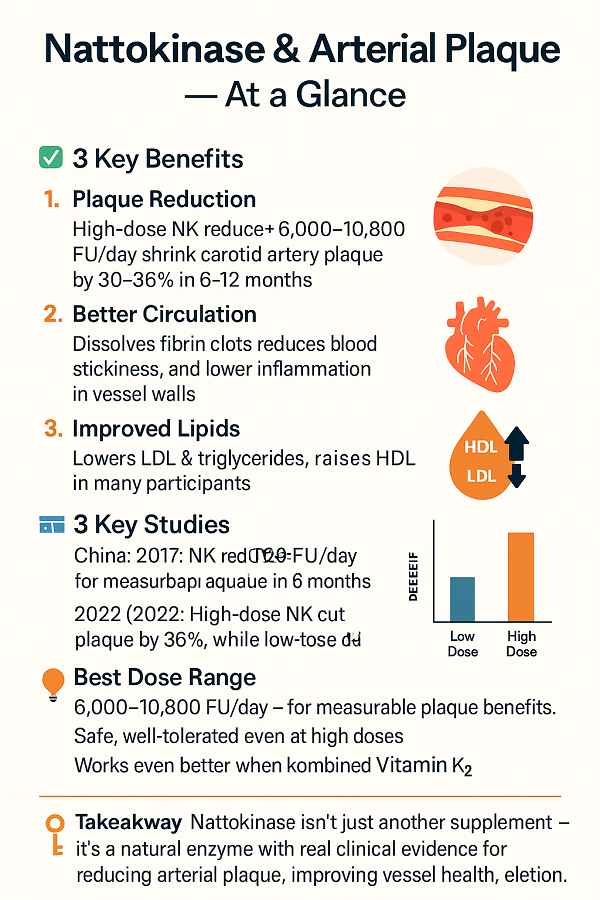
Nattokinase & Arterial Plaque — At a Glance
✅ 3 Key Benefits
-
Plaque Reduction
-
High-dose NK (6,000–10,800 FU/day) shrinks carotid artery plaque by 30–36% in 6–12 months.
-
-
Better Circulation
-
Dissolves fibrin clots, reduces blood stickiness, and lowers inflammation in vessel walls.
-
-
Improved Lipids
-
Lowers LDL & triglycerides, raises HDL in many participants.
-
📊 3 Key Studies
-
2017 (China): NK reduced plaque 3x more than a statin in 6 months.
-
2022 (China, 1,062 people): High-dose NK cut plaque by 36%, while low dose had no effect.
-
2021 (USA): Low-dose NK (2,000 FU/day) showed no benefit → dose matters.
💡 Best Dose Range
-
6,000–10,800 FU/day for measurable plaque benefits.
-
Safe, well-tolerated even at high doses.
-
Works even better when combined with Vitamin K2 (keeps calcium out of arteries).
🔑 Takeaway
Nattokinase isn’t just another supplement — it’s a natural enzyme with real clinical evidence for reducing arterial plaque, improving vessel health, and supporting circulation.
Nattokinase and Arterial Plaque: FULL
Research Overview
Introduction
Nattokinase (NK) is a serine protease enzyme extracted from natto – a traditional Japanese fermented soybean food. It gained scientific attention for its potent fibrinolytic (clot-dissolving) activitypmc.ncbi.nlm.nih.gov. Beyond fibrinolysis, NK has exhibited multiple cardiovascular benefits, including antithrombotic, antihypertensive, lipid-lowering, and anti-atherosclerotic effectspmc.ncbi.nlm.nih.gov. These properties have prompted research into NK as a natural agent for removing or reducing arterial plaque (atherosclerosis). This report summarizes findings from human clinical studies, animal experiments, and in vitro mechanistic research on NK’s impact on arterial plaque. We also discuss combination approaches (e.g. NK with vitamin K2) that may enhance its anti-atherosclerotic effects.
Human Clinical Studies on Nattokinase and Atherosclerotic Plaque
Studies in humans provide encouraging evidence that NK supplementation can slow, and even reverse, the progression of atherosclerotic plaque – particularly in the carotid arteries. Table 1 below summarizes key clinical studies, including both randomized trials and large observational data:
Table 1. Selected Human Studies of Nattokinase on Arterial Plaque
| Study (Year) | Design & Subjects | NK Dose & Duration | Plaque-Related Outcomes | Other Findings |
|---|---|---|---|---|
| Ren et al., 2017opus.lib.uts.edu.auopus.lib.uts.edu.au (China) | 76 patients with carotid atherosclerosis; Randomized to NK vs statin (simvastatin 20 mg)opus.lib.uts.edu.au. | NK 6,000 FU/day for 26 weeksopus.lib.uts.edu.au. | Carotid plaque area ↓ ~36.6% with NK vs ↓11.5% with statin (p<0.01)opus.lib.uts.edu.au. Common carotid IMT reduced significantly more in NK group (≈0.12 mm drop) than statinopus.lib.uts.edu.au. | LDL, TC, TG fell in both groups (greater reduction with statin)opus.lib.uts.edu.au. HDL rose in NK group (no change in statin group)opus.lib.uts.edu.au. NK’s plaque reduction appeared independent of lipid-loweringopus.lib.uts.edu.au. |
| Chen et al., 2022pmc.ncbi.nlm.nih.govpmc.ncbi.nlm.nih.gov (China) | 1,062 participants; 12-month open-label observational study (multi-center)pmc.ncbi.nlm.nih.govpmc.ncbi.nlm.nih.gov. | NK 10,800 FU/day (high-dose); a subset at 3,600 FU (low-dose)pmc.ncbi.nlm.nih.govpmc.ncbi.nlm.nih.gov. | Carotid intima-media thickness (IMT) ↓ ~21.7% and carotid plaque area ↓ 36% on average with 10,800 FU/day (p<0.001)pmc.ncbi.nlm.nih.govpmc.ncbi.nlm.nih.gov. ~78% of patients had plaque reductionpmc.ncbi.nlm.nih.gov. No plaque/IMT change at 3,600 FU/day (low dose ineffective)pmc.ncbi.nlm.nih.govpmc.ncbi.nlm.nih.gov. | Significant improvement in lipid profile at high dose: TC, LDL-C, TG all ↓ ~15–18%pmc.ncbi.nlm.nih.govpmc.ncbi.nlm.nih.gov. NK was well-tolerated; no adverse effects notedpmc.ncbi.nlm.nih.gov. Co-administering vitamin K2 (180 µg/day) or aspirin appeared to enhance plaque and lipid improvements (synergistic effect)pmc.ncbi.nlm.nih.govpmc.ncbi.nlm.nih.gov. |
| Hodis et al., 2021pmc.ncbi.nlm.nih.govmskcc.org (USA) | 210 healthy adults at low cardiovascular risk; Randomized, placebo-controlled trial (NK vs placebo)pmc.ncbi.nlm.nih.gov. | NK 2,000 FU/day for 3 years (dose equivalent to typical supplement)pmc.ncbi.nlm.nih.gov. | No effect on subclinical atherosclerosis progression: NK did not slow carotid IMT progression compared to placebopmc.ncbi.nlm.nih.gov. Also no significant change in arterial stiffness or plaque biomarkers vs controlmskcc.org. | No differences in cardiovascular risk markers between NK and placebo groupsmskcc.org. Authors suggest low dose was insufficient, given null results in this low-risk population. |
Key observations: Human trials indicate that high-dose NK (6,000–10,800 FU daily) can significantly regress carotid artery plaque and thickenings, whereas a standard supplement dose (2,000 FU) showed no benefit in a low-risk cohortpmc.ncbi.nlm.nih.govmskcc.org. In a 2017 trial, NK (6,000 FU) achieved greater plaque regression than a standard statin over 6 monthsopus.lib.uts.edu.au. Notably, NK’s robust plaque reduction occurred despite only modest lipid lowering, implying NK may work through mechanisms beyond cholesterol reduction (e.g. enhancing fibrinolysis or anti-inflammatory actions)opus.lib.uts.edu.au. A large 12-month study of over 1,000 subjects further confirmed that a high NK dose (10,800 FU) dramatically improved carotid IMT and plaque area, whereas one-sixth that dose was ineffectivepmc.ncbi.nlm.nih.govpmc.ncbi.nlm.nih.gov. This study also reported marked improvements in blood lipids (total cholesterol, LDL, triglycerides) in 84–95% of participants on high-dose NKpmc.ncbi.nlm.nih.govpmc.ncbi.nlm.nih.gov, alongside plaque regression in ~77% of participantspmc.ncbi.nlm.nih.gov. Importantly, no serious adverse effects were noted at 10,800 FU/day, indicating NK is well tolerated even at high dosagespmc.ncbi.nlm.nih.gov.
Animal Studies (Preclinical Evidence)
Animal models corroborate the anti-atherosclerotic effects of nattokinase, demonstrating plaque reduction and vascular protection in various settings:
-
Rats (vascular injury model): Dietary natto (fermented soybeans rich in NK) supplementation significantly suppressed intimal thickening after endothelial injury in rat arteriespmc.ncbi.nlm.nih.govpmc.ncbi.nlm.nih.gov. Treated rats showed reduced mural thrombi and intimal hyperplasia, likely due to NK’s thrombolytic activity promoting clot lysis in the injured vesselspmc.ncbi.nlm.nih.gov. A follow-up rat study by Chang et al. noted that natto extract’s protection against arterial injury was linked to antioxidant and anti-apoptotic effects in the vessel wallpmc.ncbi.nlm.nih.gov.
-
Rats (diet-induced hyperlipidemia: Other rodent studies found NK exerts hypolipidemic effects and reduces atherosclerotic changes. For example, NK supplementation in cholesterol-fed rats decreased LDL oxidation and improved lipid metabolism, thereby preventing arteriosclerotic changes in the aortapmc.ncbi.nlm.nih.govpmc.ncbi.nlm.nih.gov. NK-fed rats had lower LDL levels and less lipid peroxidation than controlspmc.ncbi.nlm.nih.gov.
-
Rabbits (atherosclerosis model): In a rabbit model of diet-induced atherosclerosis, NK combined with Korean red ginseng significantly reduced the area of aortic plaques compared to rabbits fed a high-cholesterol diet without NKpmc.ncbi.nlm.nih.gov. The NK+ginseng group also showed improved plasma lipids, suggesting a synergistic benefit in slowing plaque formationpmc.ncbi.nlm.nih.gov.
-
Mice (genetic atherosclerosis model): Recent research in LDL receptor–knockout mice (a model prone to atherosclerosis) further highlights NK’s benefits in the context of natto. Mice fed natto demonstrated significantly less aortic plaque buildup than controls, especially when consuming natto with high vitamin K2 contentnature.com. Natto-fed mice had reduced aortic lipid staining and fewer fluorescent foam cells in lesionsnature.com. Mechanistically, natto intake altered gut microbiota and lowered inflammatory signaling (serum CCL2) while raising anti-inflammatory IL-10 in micenature.com. This suggests NK (and/or natto’s vitamin K2) can inhibit atherogenesis by reducing inflammation in addition to its direct enzymatic fibrin degradation.
Summary: Across animal studies, NK consistently shows anti-atherosclerotic effects: it prevents intimal thickening and accelerates clot clearance after arterial injurypmc.ncbi.nlm.nih.govpmc.ncbi.nlm.nih.gov, reduces lipid accumulation and oxidative stress in arteriespmc.ncbi.nlm.nih.gov, and shrinks atherosclerotic plaques in diet-induced modelspmc.ncbi.nlm.nih.gov. These benefits are observed both with purified NK and with natto-rich diets, underscoring NK’s biological activity in vivo. The animal data also point to multiple mechanisms (thrombolysis, lipid lowering, anti-oxidation, anti-inflammation) by which NK combats plaque development.
In Vitro and Mechanistic Studies
Laboratory (in vitro) experiments have helped elucidate how nattokinase acts on the molecular level to protect blood vessels and reduce plaque-related processes. Key mechanistic findings include:
-
Fibrinolysis and Thrombus Degradation: NK’s original discovery was based on its ability to digest fibrin clots in vitropmc.ncbi.nlm.nih.gov. It directly degrades fibrin and also activates other fibrinolytic enzymes (like prourokinase)pmc.ncbi.nlm.nih.gov. This clot-busting property can prevent fibrin deposition in arteries, important because developing plaques often contain fibrin and thrombi. In vitro and ex vivo studies show NK reduces platelet aggregation and thrombus formation in a dose-dependent mannermskcc.org. By keeping blood free of microclots, NK may reduce the pro-thrombotic environment that accelerates plaque growth.
-
Endothelial Protection & Anti-Inflammatory Effects: A 2024 study by Chiu et al. demonstrated that NK directly attenuates vascular inflammation in endothelial cellsnattiase.comnattiase.com. In cultured human endothelial cells, NK treatment upregulated the Serum Response Factor (SRF) and Thrombospondin-1 (THBS1) genes, which promote cellular repair and anti-inflammatory autophagy pathwaysnattiase.com. NK increased markers of autophagy (LC3, beclin-1) that help cells clear damaged proteins and curb inflammationnattiase.com. At the same time, NK suppressed activation of the NLRP3 inflammasome (reducing ASC and cleaved caspase-1 levels) and inhibited necroptosis signaling (downregulating phosphorylated RIP1/RIP3) in endothelial cellsnattiase.com. These actions translate to less endothelial cell injury and inflammation – crucial for slowing atherosclerosis initiation.
-
Vascular Inflammation In Vivo: The above 2024 study also tested NK in a mouse model of acute vascular inflammation. Mice given NK (2,000 or 4,000 FU/kg) during inflammatory challenge showed reduced expression of adhesion molecules (ICAM-1, VCAM-1, E-selectin) on their blood vessel wallsnattiase.com. These molecules drive leukocyte recruitment into plaques; NK’s ability to lower their levels indicates a blunted inflammatory response. NK-treated mice also had less aortic wall thickening than untreated controlsnattiase.com, signifying protection against inflammation-induced arterial remodeling. These findings align with NK’s observed anti-inflammatory benefits in animals (e.g. lower CCL2 in natto-fed mice) and humans (where NK improved inflammatory profiles in some studies).
-
Antioxidant and Lipid Effects: In vitro biochemical assays have shown NK (or natto extracts) can inhibit LDL oxidationpmc.ncbi.nlm.nih.gov – a key step in plaque formation. An early study found natto’s components had antioxidant activity that reduced LDL oxidation in cholesterol-fed ratspmc.ncbi.nlm.nih.gov. By preventing oxidative modification of LDL, NK may reduce foam cell formation in arterial walls. NK has also been observed to upregulate antioxidant enzymes in some cell modelspmc.ncbi.nlm.nih.gov. Additionally, while NK is not a potent lipid-lowering drug, 8–12 week pilot trials in humans showed trends of lowered LDL and triglycerides with NK supplementationpmc.ncbi.nlm.nih.gov. In combination with other supplements (see below), NK’s modest lipid improvements could contribute to plaque stabilization.
In summary, mechanistic studies depict NK as a multifaceted anti-atherosclerotic agent: it dissolves fibrin clots, reduces blood viscosity and platelet aggregation, calms endothelial inflammation by modulating gene expression and cytokine release, and guards against oxidative LDL damage. These cellular actions help explain the significant plaque regression seen in clinical and animal studies.
Nattokinase in Combination with Vitamin K2 and Other Compounds
Researchers have explored pairing nattokinase with other nutrients to enhance cardiovascular benefits. Vitamin K2 (especially as MK-7) is a noteworthy companion to NK, since natto is naturally rich in K2 and both have complementary effects on vascular health:
-
Synergy with Vitamin K2: In the 1,062-patient study (Chen et al. 2022), a subgroup analysis revealed that patients taking vitamin K2 (180 µg MK-7 daily) along with NK had greater improvements in blood lipids than those on NK alonepmc.ncbi.nlm.nih.gov. Co-administration of K2 amplified NK’s cholesterol-lowering effect, suggesting a synergistic interactionpmc.ncbi.nlm.nih.gov. Although plaque-specific outcomes were not significantly different with K2 in that study, the overall atherosclerosis outcomes improved when NK and K2 were combinedpmc.ncbi.nlm.nih.govpmc.ncbi.nlm.nih.gov. The authors noted that it’s unclear why K2 boosts NK’s action, but K2’s known benefits on bone and cardiovascular health (e.g. promoting calcium deposition in bone and preventing arterial calcification) may play a rolepmc.ncbi.nlm.nih.gov. Indeed, separate studies of vitamin K2 alone have shown it can slow the progression of arterial calcification and thickeninglifeextension.comlifeextension.com. By activating Matrix Gla Protein and other calcium-regulating factors, K2 helps keep calcium out of plaques, thereby stabilizing or reducing plaque burdennature.com. Thus, combining NK’s fibrinolytic and anti-inflammatory effects with K2’s anti-calcific action is a logical strategy for arterial plaque management. Early data indicate this duo is promising, and it mirrors the traditional Japanese diet where natto (NK source) provides abundant K2 naturally.
-
Natto as NK+K2 Food: The natto consumption mouse study (Scientific Reports 2023) underscores the NK–K2 synergy. Mice fed natto high in K2 had the greatest reduction in aortic plaque, whereas natto with lower K2 was less effectivenature.comnature.com. This implies K2 content was a decisive factor in natto’s anti-atherosclerotic impact, alongside NK. Moreover, population studies in Japan correlate higher natto intake with lower cardiovascular mortalitypmc.ncbi.nlm.nih.gov, an effect attributed to both NK and K2 in natto. These lines of evidence strengthen the case that NK + vitamin K2 together confer broader anti-atherosclerotic protection than either alone.
-
Combination with Other Supplements: Other compounds have also been tested with NK. For example, red yeast rice (RYR), which contains natural statin-like monacolins, was combined with NK in a 2024 randomized trial. In 90 days, the NK+RYR combination led to significantly larger reductions in LDL, triglycerides, and blood pressure compared to NK or RYR alonefrontiersin.orgfrontiersin.org. (Plaque size was not measured in that short trial, but the improved risk factors suggest potential plaque benefits over longer term.) Another enzyme, lumbrokinase (from earthworms), with similar fibrinolytic activity, has been paired with statins and shown additive reductions in carotid IMT in a small studykahnlongevitycenter.com. These findings imply that naturopathic combinations can be an effective strategy: NK can be an adjunct to lipid-lowering or anti-platelet therapies, enhancing overall cardiovascular protection. In the high-dose NK study, concurrent low-dose aspirin use also had a synergistic effect (further improving lipid profiles and presumably plaque outcomes)pmc.ncbi.nlm.nih.govpmc.ncbi.nlm.nih.gov – likely because both aspirin and NK inhibit platelet aggregation via overlapping pathwayspmc.ncbi.nlm.nih.gov.
In practice, adding vitamin K2 is often recommended when using NK long-term, to support vascular calcium balance and bone health. The current evidence indicates that such combinations are safe and may yield a broader anti-atherosclerotic effect than NK alone, though more targeted studies are needed to confirm long-term plaque outcomes.
Conclusion
Research to date – spanning in vitro experiments, animal models, and human trials – suggests that nattokinase is a promising nutraceutical for combatting arterial plaque. High doses of NK have demonstrated the ability to shrink atherosclerotic plaques and reduce artery wall thickness in humanspmc.ncbi.nlm.nih.govpmc.ncbi.nlm.nih.gov, with efficacy approaching that of conventional statins in at least one studyopus.lib.uts.edu.au. Unlike typical lipid-lowering drugs, NK may achieve plaque regression through a combination of fibrinolysis, anti-inflammatory action on blood vessels, and improving blood lipid profiles. Animal studies reinforce these benefits, showing NK can prevent plaque formation and even reverse early-stage lesions through thrombolytic and antioxidant mechanismspmc.ncbi.nlm.nih.govpmc.ncbi.nlm.nih.gov.
Importantly, NK has been well-tolerated in clinical studies (even at 10,800 FU/day for 12 months) with no significant adverse effects reportedpmc.ncbi.nlm.nih.gov. This safety profile, combined with its plaque-reducing potential, makes NK an attractive adjunct or alternative in cardiovascular prevention. However, dose appears to be critical – low-dose NK (2,000 FU/day) was not effective for atherosclerosis in a rigorously controlled studypmc.ncbi.nlm.nih.gov. Thus, future research and clinical use should consider an adequate dosing strategy (possibly in the range of 6,000–10,000 FU daily) to achieve therapeutic effects on plaques.
In summary, nattokinase alone – and especially in combination with vitamin K2 – has emerged as a compelling natural approach to target arterial plaque. While more large-scale, placebo-controlled trials are warranted to solidify its role, the existing evidence (both peer-reviewed studies and mechanistic insights) indicates that NK can reduce arterial plaque burden, improve vascular function, and slow atherosclerotic disease progressionpmc.ncbi.nlm.nih.govnattiase.com. As part of an integrative strategy (including diet, exercise, and standard care), NK may offer additional protection for individuals at risk of cardiovascular events due to atherosclerosis. Researchers are continuing to investigate NK’s full potential, but it already represents a novel tool for cardiovascular health grounded in both traditional food practice and modern scientific validation.
Sources:
-
Chen H. et al. (2018). Nattokinase: A Promising Alternative in Prevention and Treatment of Cardiovascular Diseases. Biomarker Insights, 13, 1177271918785130. pmc.ncbi.nlm.nih.govpmc.ncbi.nlm.nih.gov
-
Chen H. et al. (2022). Effective management of atherosclerosis progress and hyperlipidemia with nattokinase: A clinical study with 1,062 participants. Front. Cardiovasc. Med., 9, 1049135. pmc.ncbi.nlm.nih.govpmc.ncbi.nlm.nih.gov
-
Ren N. et al. (2017). A clinical study on the effect of nattokinase on carotid artery atherosclerosis and hyperlipidaemia. Nat Med J China, 97(26):2038–42. opus.lib.uts.edu.auopus.lib.uts.edu.au
-
Hodis HN et al. (2021). Nattokinase Atherothrombotic Prevention Study: A randomized controlled trial. Clin Hemorheol Microcirc, 78(4):339–353. pmc.ncbi.nlm.nih.govmskcc.org
-
Suzuki Y. et al. (2003). Dietary supplementation with fermented soybeans suppresses intimal thickening (rat study). Nutrition, 19(3):261–4. pmc.ncbi.nlm.nih.gov
-
Chang CH. et al. (2010). Effects of natto extract on endothelial injury in a rat model. Acta Med. Okayama, 64:399–406. pmc.ncbi.nlm.nih.govpmc.ncbi.nlm.nih.gov
-
Kang SJ. et al. (2014). Korean red ginseng combined with nattokinase ameliorates dyslipidemia and aortic plaque in rabbits. Food Sci Biotechnol., 23:283–7. pmc.ncbi.nlm.nih.gov
-
Kawamata T. et al. (2023). Natto consumption suppresses atherosclerotic plaque progression in LDL receptor-deficient mice. Sci Reports, 13:22469. nature.comnature.com
-
Chiu HW. et al. (2024). Nattokinase attenuates endothelial inflammation through activation of SRF and THBS1. Int J Biol Macromol, 268:131779. nattiase.comnattiase.com
-
Sloan-Kettering Cancer Center – About Herbs: Nattokinase (2022 update). mskcc.orgmskcc.org
-
Life Extension Magazine. Vitamin K2 Reduces Atherosclerosis (2016). lifeextension.comlifeextension.com
